A data-driven look at how the AI boom is reshaping the San Francisco housing market. The city is in one of its strongest spring markets in years, with demand surging and inventory down sharply. But the heat is concentrated, strongest in single-family homes and the cash-paying luxury tier, and notably softer in the high-rise condos closest to the new AI offices. Every figure here is drawn from the San Francisco Multiple Listing Service.
A rolling 12-month window (June 2025–May 2026) measured against the prior 12 months (June 2024–May 2025). Using a full year on each side smooths out seasonal swings and gives a steadier read of where each property type stands. Single family is the engine; the other types are firming rather than frothing.
| Property type | Median price (year over year) | Median $/SqFt | Days on market | Sale vs list | % over list | Financed |
|---|---|---|---|---|---|---|
| Single Family | $1.77M (+9.4%) | $1,017 | 13 | 114% | 80% | 75% |
| Condo / Townhouse | $1.17M (+5.9%) | $997 | 26 | 100% | 43% | 67% |
| Tenancy in Common | $1.06M (−4.1%) | $866 | 37 | 100% | 50% | 78% |
| Multi-Unit (2–4+) | $2.0M (+6.7%) | $539 | 31 | 100% | 43% | 74% |
These charts trace the full arc of our data. The story: single family is now at the top of the 11-year range on price and competition. Most San Francisco buyers still use financing, though that share has shifted as new AI-era cash has entered the market, the flip side of the same story.
Break each property type into price bands and the behavior diverges sharply. Single-family competition peaks in the move-up middle ($1.5M–3M), not at the entry or the top. Condos run cooler at every band. Most buyers use financing across nearly every segment, though the financed share drops at the very top of the market. Trailing twelve months of closed sales.
| Price band | Type | Closed | Sale/list | % over | Days | Financed |
|---|
How to read it: at $1.0–1.5M a single-family home sells over asking 82% of the time in about 14 days; a condo at the same price does so just 50% of the time and takes about 21 days. Same dollar amount, very different competitive reality. Entry-level condos (under $1M) are the softest segment in the city, 45 days on market and only 27% over asking, the same SoMa / downtown weakness seen in the district view.
Where the competition actually lives. The San Francisco Multiple Listing Service breaks the city into 10 districts; the labels below show the main neighborhoods each one covers. Figures are the January–April window for 2026, measured against each district's own 11-year peak. Toggle between single family and condo to see how differently the two markets are behaving.
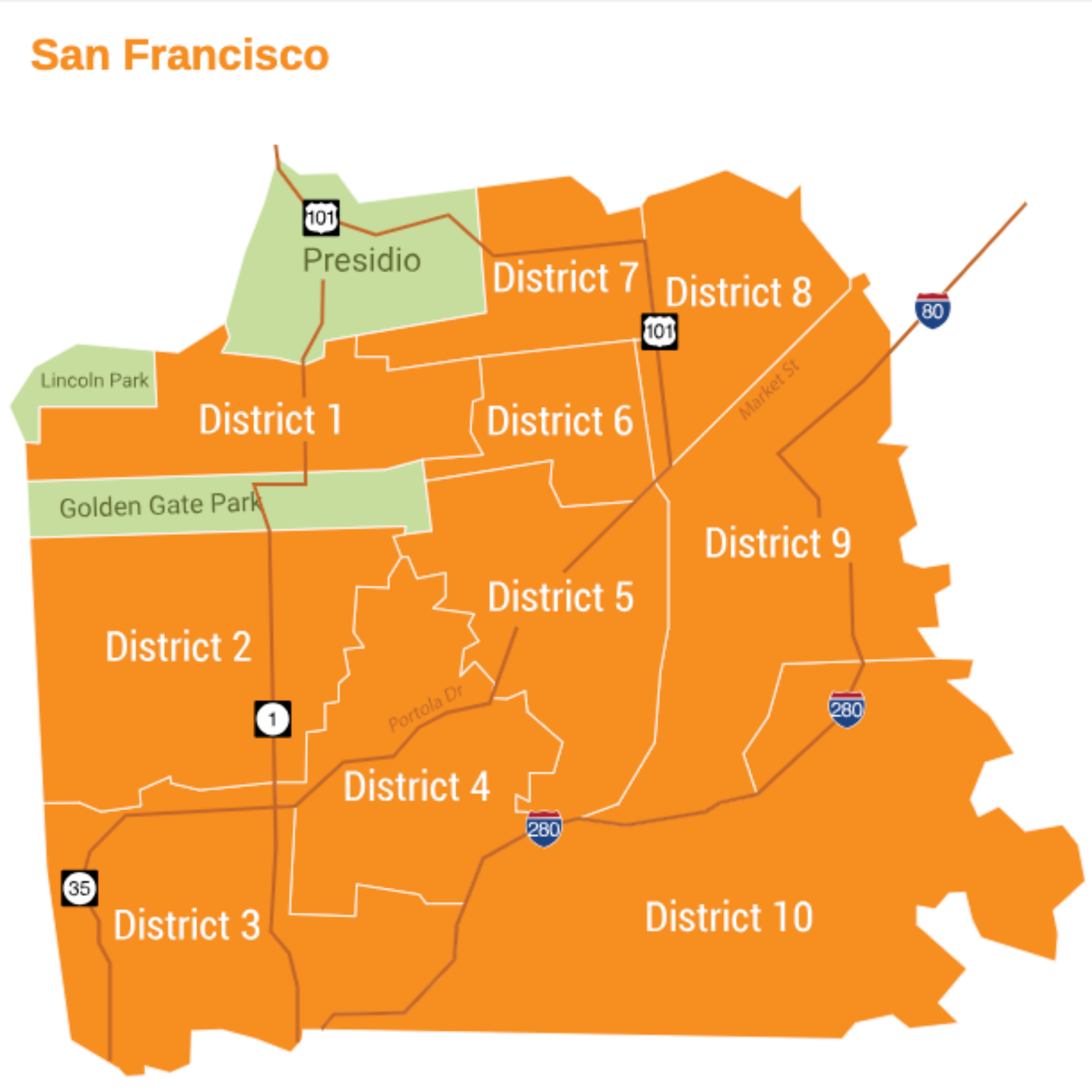
| District | Median | $/SqFt | Sale/list | % over | Peak (yr) |
|---|
Luxury, defined as $5M+ single-family homes and $3M+ condos (roughly the top 5% of sales), is where AI-era wealth shows up most clearly. At the top, most deals skip the lender.
Here is the most interesting story in the data, and the one most market commentary misses. The capital is real, but it is not lifting everything evenly.
The takeaway for buyers and sellers: a genuinely strong market led by single family and luxury, with real opportunity remaining in the condo segment near the AI corridor. The open question for the next two years is whether AI capital broadens into jobs and household formation, which is what would make the cycle durable.
Numbers are only useful if they change what you do. Here is how this market translates into strategy on each side of the table.
The one rule for both sides: in San Francisco, the asset still matters. Two homes five blocks apart can carry very different risk. The headline tells you the weather; the specific property, financing, and block tell you what to actually do.
Whether you are weighing a move or just want to understand where your neighborhood actually stands, I am happy to talk it through. No pressure, just a clear, honest read on the market.
Email Paulo Call (408) 834-9161 Follow @sfrealtorPaulo Download the 1-page brief (PDF)